
Education


Experience


Visitor Map
I am currently a postdoctoral fellow at the School of Engineering, The University of British Columbia, Kelowna, BC, Canada, where I am working with Prof. Anas Chaaban and Prof. Md. Jahangir Hossain. Previously, I earned my Ph.D. in the Electrical and Computer Engineering Program at the Computer, Electrical, and Mathematical Sciences and Engineering (CEMSE) Division, King Abdullah University of Science and Technology (KAUST), Thuwal, KSA, under the supervision of Prof. Tareq Al-Naffouri. Prior to that, I received the B.S. and M.S. degrees from the Harbin Institute of Technology (HIT), China. My research interests lie in signal processing, deep learning, wireless communications, and radio localization.
Warning
Problem: The current name of your GitHub Pages repository ("Solution: Please consider renaming the repository to "
http://".
However, if the current repository name is intended, you can ignore this message by removing "{% include widgets/debug_repo_name.html %}" in index.html.
Action required
Problem: The current root path of this site is "baseurl ("_config.yml.
Solution: Please set the
baseurl in _config.yml to "News
Research Highlights
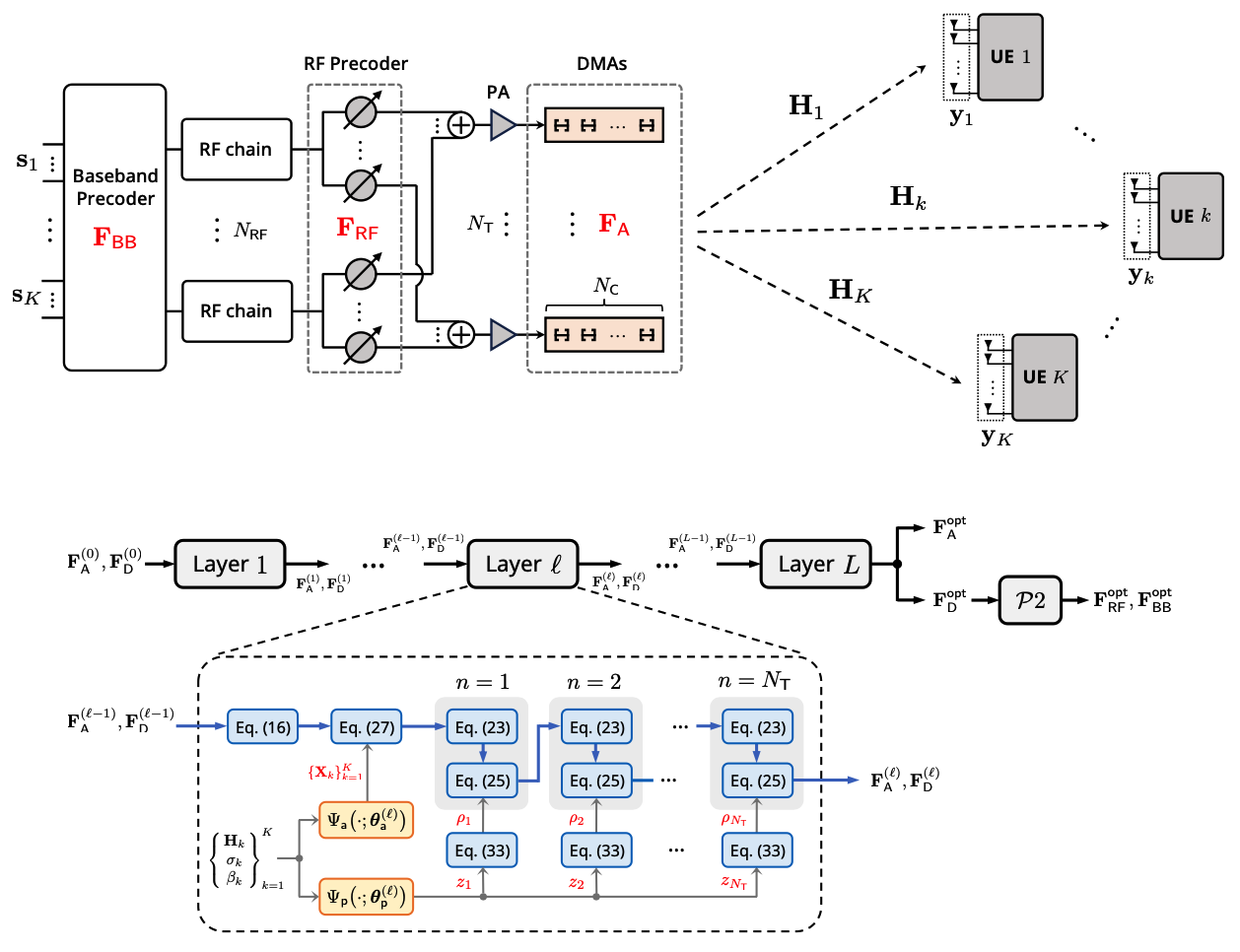
Fast Tri-Hybrid Beamforming via Deep Unfolding
Pinjun Zheng†, Md. Jahangir Hossain, Anas Chaaban
IEEE Transactions on Signal Processing
Journal
This work develops a fast tri-hybrid precoding algorithm based on the deep unfolding approach, tightly integrating model-based principles and data-driven techniques.
Fast Tri-Hybrid Beamforming via Deep Unfolding
Pinjun Zheng†, Md. Jahangir Hossain, Anas Chaaban
IEEE Transactions on Signal Processing Journal
This work develops a fast tri-hybrid precoding algorithm based on the deep unfolding approach, tightly integrating model-based principles and data-driven techniques.
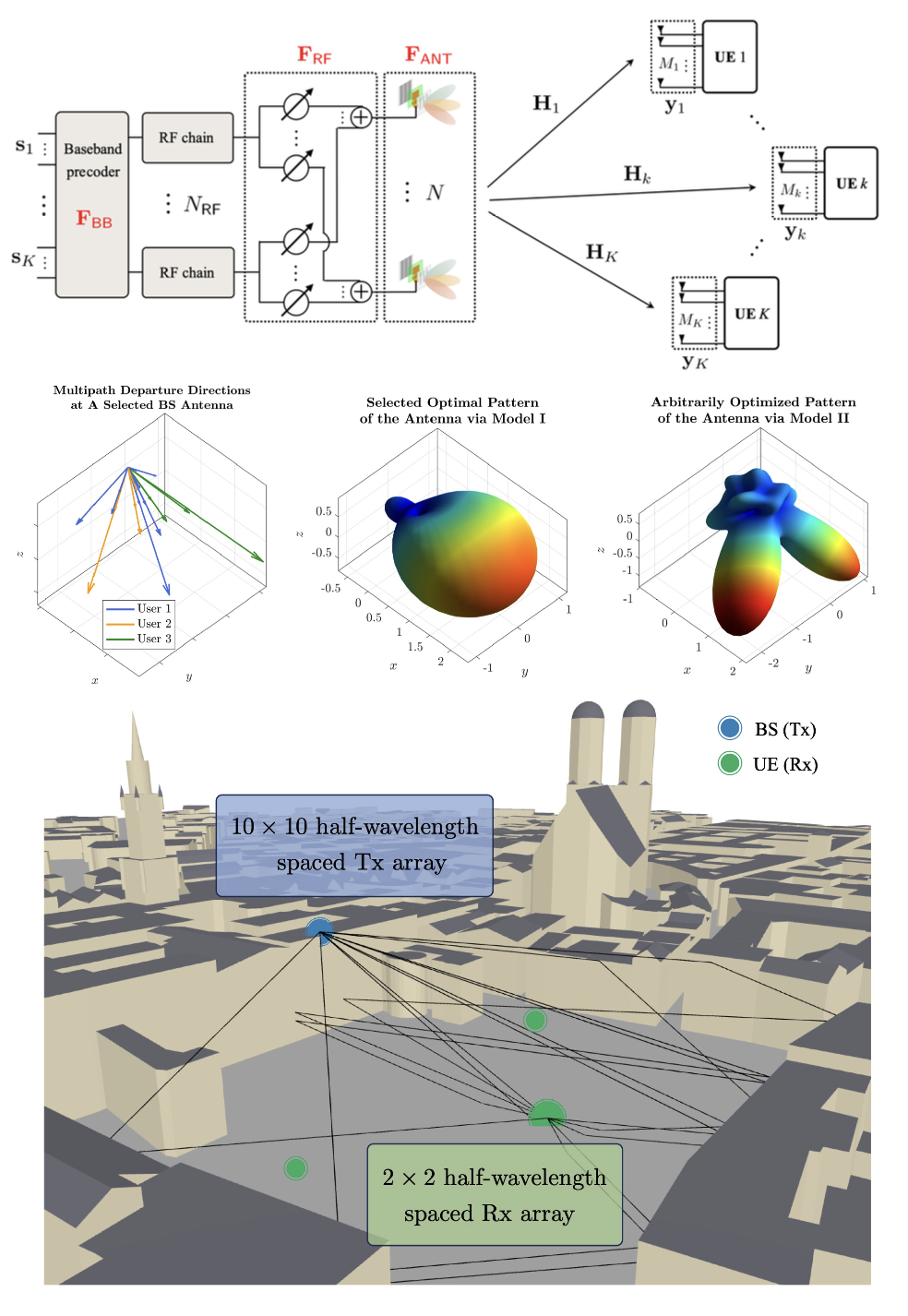
Tri-Hybrid Multi-User Precoding Using Pattern-Reconfigurable Antennas: Fundamental Models and Practical Algorithms
Pinjun Zheng†, Yuchen Zhang, Tareq Y. Al-Naffouri, Md. Jahangir Hossain, Anas Chaaban
IEEE Transactions on Communications
Journal
In this work, we investigate a tri-hybrid MIMO architecture for multi-user communication that combines digital, analog, and antenna-domain precoding through the use of pattern-reconfigurable antennas. We develop two foundational models to characterize the tri-hybrid MIMO system, propose corresponding precoding algorithms with quadratic complexity, and evaluate system performance using realistic ray-tracing simulations.
Tri-Hybrid Multi-User Precoding Using Pattern-Reconfigurable Antennas: Fundamental Models and Practical Algorithms
Pinjun Zheng†, Yuchen Zhang, Tareq Y. Al-Naffouri, Md. Jahangir Hossain, Anas Chaaban
IEEE Transactions on Communications Journal
In this work, we investigate a tri-hybrid MIMO architecture for multi-user communication that combines digital, analog, and antenna-domain precoding through the use of pattern-reconfigurable antennas. We develop two foundational models to characterize the tri-hybrid MIMO system, propose corresponding precoding algorithms with quadratic complexity, and evaluate system performance using realistic ray-tracing simulations.
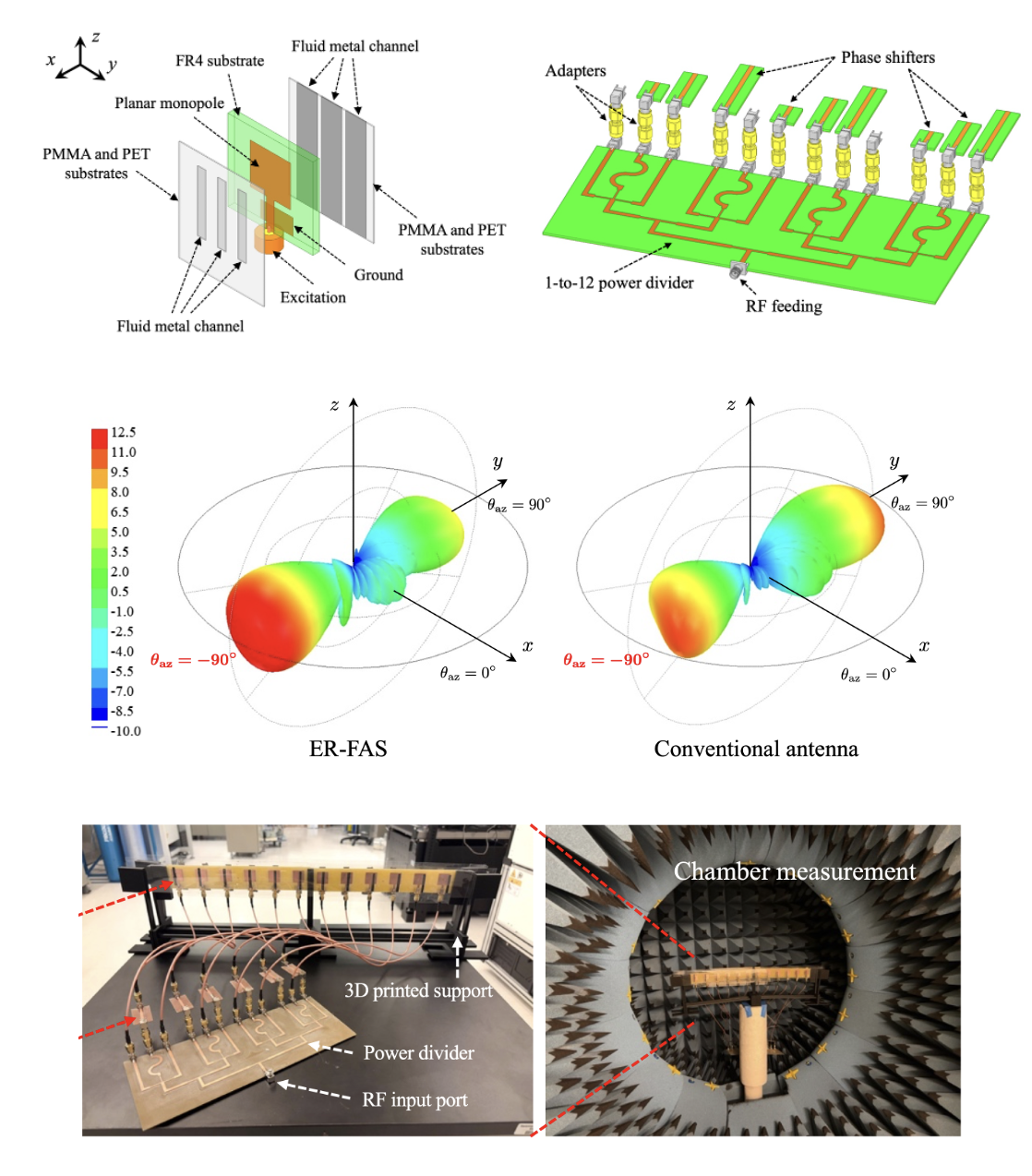
Electromagnetically Reconfigurable Fluid Antenna System for Wireless Communications: Design, Modeling, Algorithm, Fabrication, and Experiment
Ruiqi Wang, Pinjun Zheng†, Vijith Varma Kotte, Sakandar Rauf, Yiming Yang, Muhammad Mahboob Ur Rahman, Tareq Y. Al-Naffouri, Atif Shamim
IEEE Journal on Selected Areas in Communications
Journal
This paper presents the concept, design, channel modeling, beamforming algorithm, prototype fabrication, and experimental measurement of an electromagnetically reconfigurable fluid antenna system (ER-FAS), in which each FAS array element features electromagnetic (EM) reconfigurability. Unlike most existing FAS works that investigate spatial reconfigurability, the proposed ER-FAS enables direct control over the EM characteristics of each element, allowing for dynamic radiation pattern reconfigurability.
Electromagnetically Reconfigurable Fluid Antenna System for Wireless Communications: Design, Modeling, Algorithm, Fabrication, and Experiment
Ruiqi Wang, Pinjun Zheng†, Vijith Varma Kotte, Sakandar Rauf, Yiming Yang, Muhammad Mahboob Ur Rahman, Tareq Y. Al-Naffouri, Atif Shamim
IEEE Journal on Selected Areas in Communications Journal
This paper presents the concept, design, channel modeling, beamforming algorithm, prototype fabrication, and experimental measurement of an electromagnetically reconfigurable fluid antenna system (ER-FAS), in which each FAS array element features electromagnetic (EM) reconfigurability. Unlike most existing FAS works that investigate spatial reconfigurability, the proposed ER-FAS enables direct control over the EM characteristics of each element, allowing for dynamic radiation pattern reconfigurability.
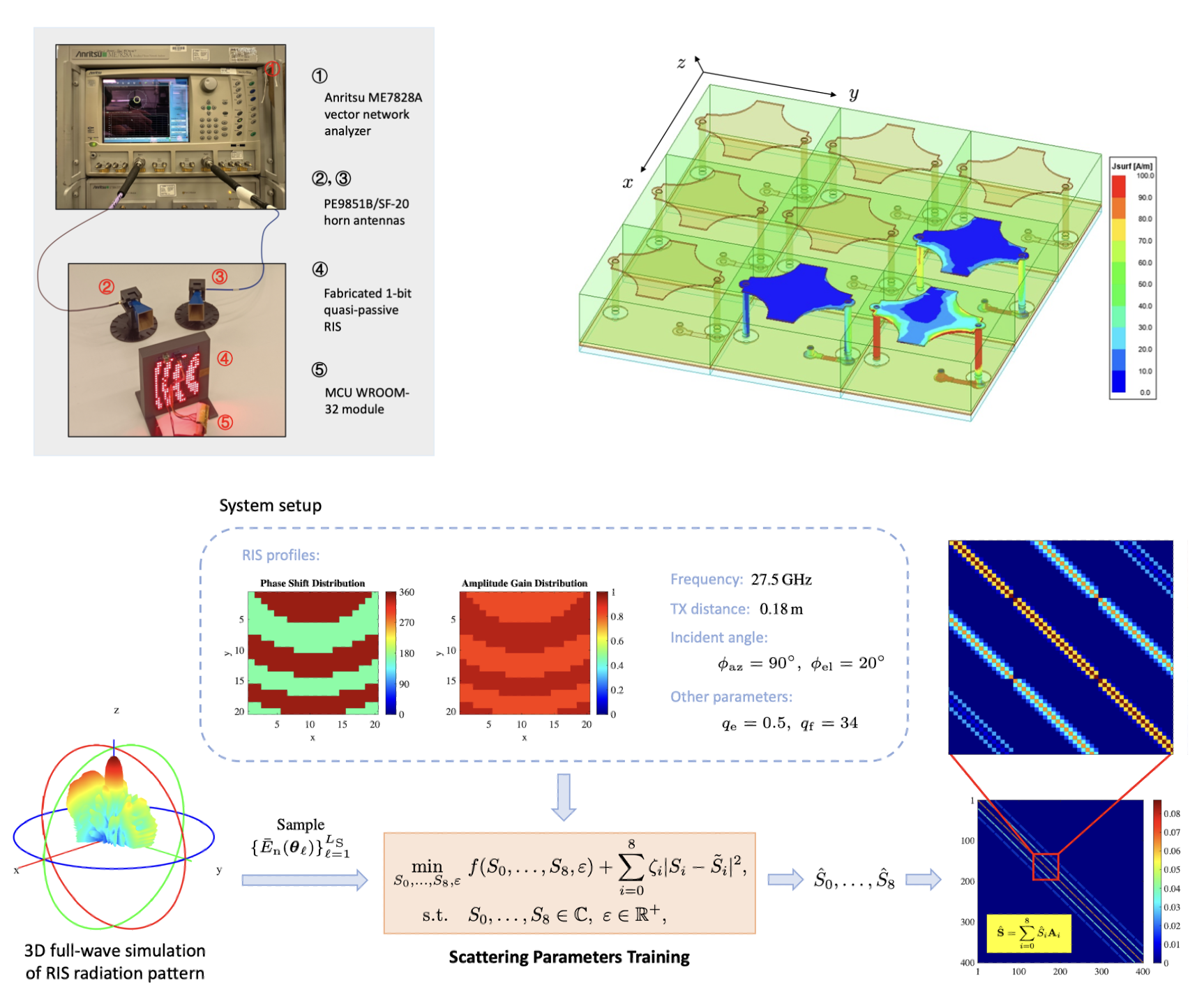
Mutual Coupling in RIS-Aided Communication: Model Training and Experimental Validation
Pinjun Zheng, Ruiqi Wang†, Atif Shamim, Tareq Y. Al-Naffouri
IEEE Transactions on Wireless Communications
Journal
We show how to properly model the RIS mutual coupling within the cascaded channel and how to obtain a realistic evaluation of the scattering parameters in the model based on a real RIS prototype. Both full-wave simulation and experimental validation are conducted.
Mutual Coupling in RIS-Aided Communication: Model Training and Experimental Validation
Pinjun Zheng, Ruiqi Wang†, Atif Shamim, Tareq Y. Al-Naffouri
IEEE Transactions on Wireless Communications Journal
We show how to properly model the RIS mutual coupling within the cascaded channel and how to obtain a realistic evaluation of the scattering parameters in the model based on a real RIS prototype. Both full-wave simulation and experimental validation are conducted.